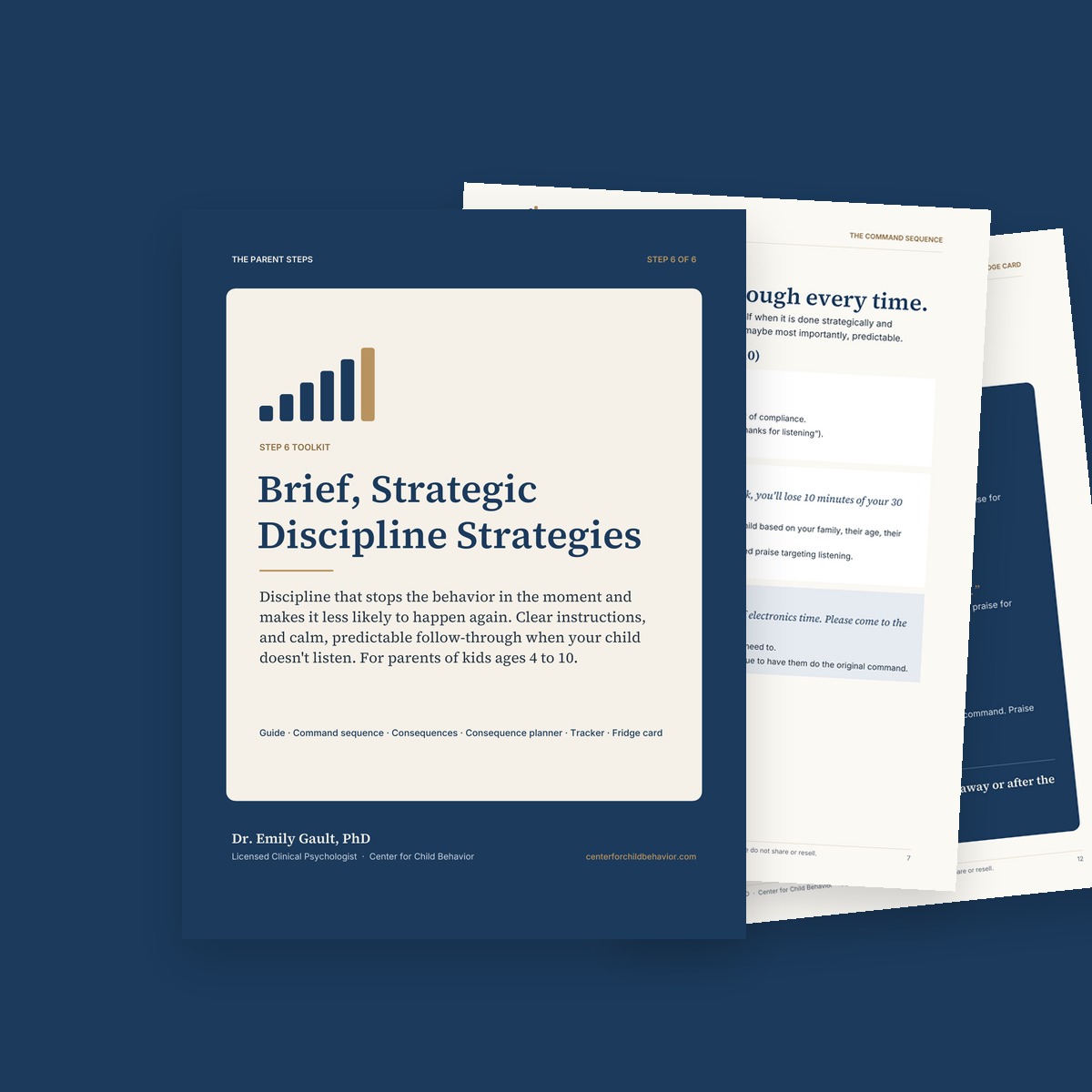
Use brief discipline that stops the behavior now and makes it less likely later.
Give direct commands and use the 3-step command sequence, every time.
Choose brief consequences that teach, and plan them ahead.
Brief and strategic, not harsh
Yes, you should say no and set boundaries. The goal of discipline isn't only to stop the behavior in the moment. It's to make it less likely to happen again. Long, harsh, or unpredictable punishments might stop a behavior for now, but they rarely change it for the long run. The key is to be calm, matter-of-fact, and predictable. A direct command tells your child exactly what to do. A calm warning gives them a chance to listen. A brief consequence that happens every time teaches more than a big one that happens sometimes. If your child only listens when you yell, it's likely because yelling has been the most predictable thing in the house. The command sequence changes that.
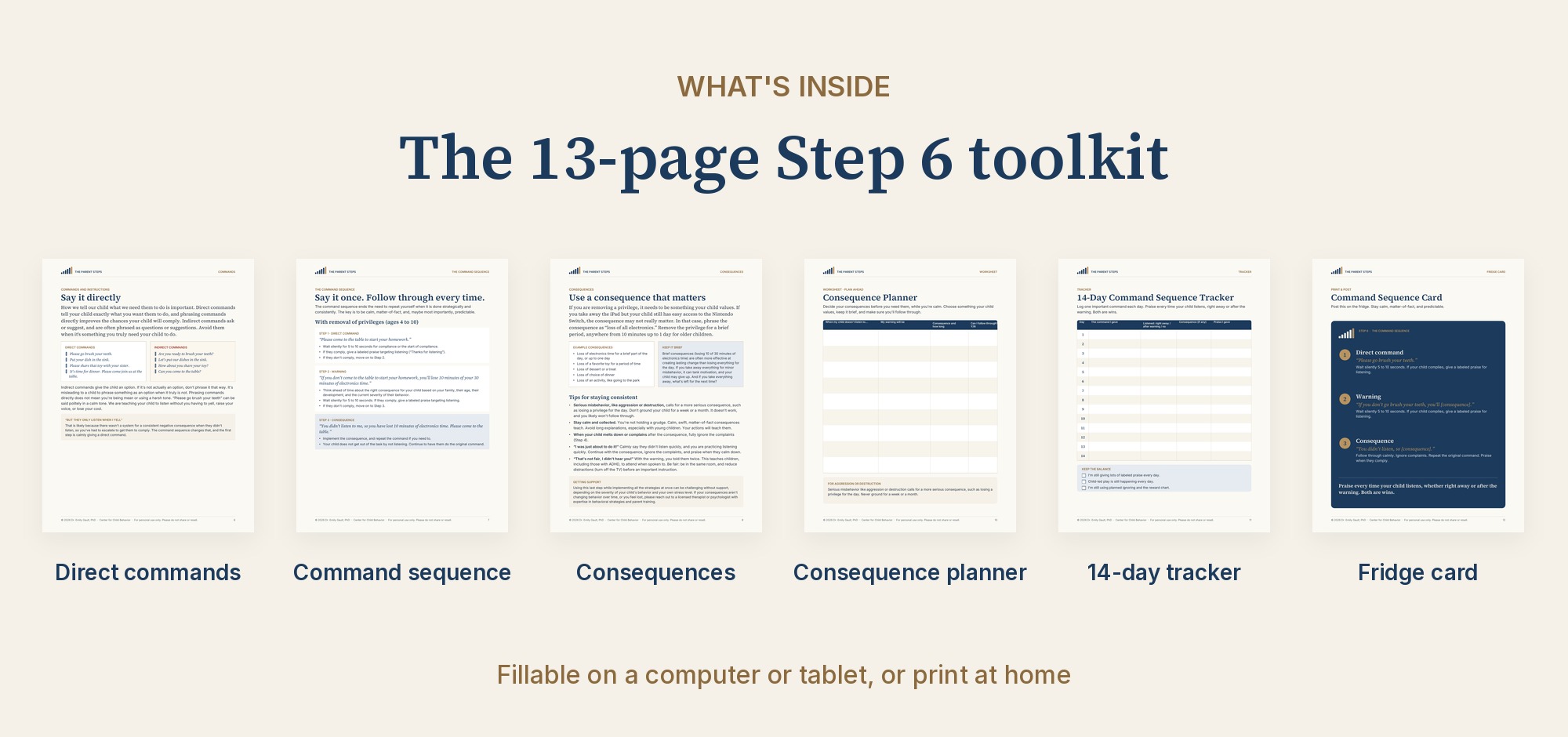
What's inside the 13-page toolkit
• A short ABCs primer, so you know where discipline fits • Direct vs. indirect commands, with examples • The 3-step command sequence, with a real example • How to choose consequences that matter, plus tips for staying consistent • Five thinking traps that get in the way, and what to think instead • A fillable Consequence Planner and a 14-day Command Sequence Tracker • A Command Sequence fridge card

Meet Dr. Emily Gault, PhD
I'm a licensed clinical psychologist. My training took me through Georgetown University, LSU, the University of Miami, and Florida International University, including an NIH-funded T32 postdoctoral fellowship, before I joined the faculty at FIU as a Research Assistant Professor. In 2023, I left academic research to open the Center for Child Behavior, my private practice focused on bringing families the research-supported tools that help children with significant behavioral difficulties. I have 10 years of experience providing comprehensive assessment and therapy for children with behavior challenges, and I've authored ~40 scientific publications on oppositional behavior, conduct problems, aggression, ADHD, and related topics. Today, I provide telehealth behavioral parent training for families across Florida. The Parent Steps is the six-step program I use with the families I work with, now available for any parent to use at home.
Common questions
What ages is this for? Kids ages 4 to 10. The same science applies to toddlers and teens, but it's tailored differently for those ages. Will this help if my child has ADHD? Yes. The command sequence teaches kids, including kids with ADHD, to tune in when spoken to. The toolkit also shows you how to set your child up to succeed, like reducing distractions before an important instruction. Is this a physical product? No. It's a digital PDF you can download right after purchase. The worksheets are fillable on a computer or tablet, or you can print them. Is this therapy? No. This is educational and isn't a substitute for therapy or medical advice, and purchase does not create a therapist-client relationship. If your child has significant behavioral concerns, please reach out to a licensed provider. Do I need the earlier steps first? Yes, ideally. Discipline works best on top of praise, child-led play, planned ignoring, and rewards. Using consequences without them is a common reason discipline fails. The Complete Bundle includes all six toolkits plus a Start Here guide.
Brief, calm, and effective.
Instant download, fillable on a computer or tablet, or print at home.
$12.00